

Brainspotting

Phase 1 Training

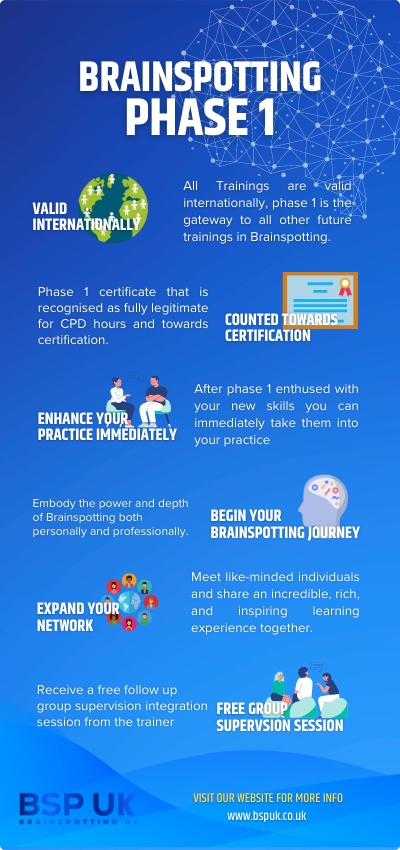
  • Learn the phenomenological approach that underpins Brainspotting, followed by clear strategies for identifying and processing Brainspots.
  • Take the newly learned techniques into your practice immediately after training
  • Meet like-minded individuals in our exceptional community and share an incredible, rich, connected, and inspiring learning journey
  • Receive guidance towards your International practitioner certification
  • Training is credited with CPD hours and certification
  • Receive a free follow-up group supervision integration session from the trainer

Begin your Brainspotting training

  • Trainings are internationally recognised
  • Phase 1 is the gateway to all other future trainings in Brainspotting.

About phase 1 training

This immersive 3-day training will teach participants the key concepts of Brainspotting. By the end of this training, you will be competent in identifying and processing Brainspots. You will also learn the phenomenological approach that underpins strategies for  Brainspotting. This training will give participants powerful tools which will enable their clients to quickly and effectively focus and process through the deep brain sources of many emotional, somatic and performance problems. Once certified in Phase 1, the participant will be able to complete all other future trainings in Brainspotting.

By the end of this incredible 3 day training you will…

Understand the theory and the components of Brainspotting, be able to utilise the following techniques:

Outside window

This technique will help you observe and learn to track the micro-movements of your client, searching for reflective responses. When a Brainspot is activated, the deep brain appears to reflectively signal the therapist, beyond the awareness of the client’s neocortex.  You will literally learn how the body indicates the trauma processing access points.

Inside window

This technique will allow you to work together with the client to use the client’s felt sense of somatic activation to locate Brainspots.  An incredible and collaborative way for the client, the therapist and the issue to forge a powerful alliance together.

Gazespotting

This technique is the most natural form of Brainspotting, whereby the client’s fixed gaze can be harnessed to process activation.  This approach is extremely helpful in utilising Brainspotting both in the room or when working online.

Resource model

Brainspotting is a resource model.  The Brainspotting Resource model uses an adapted and contained frame for clients who become overwhelmed. You will embody the learning of the dual attunement frame, consisting of the relational attunement, accurately focused and framed by the neurobiological attunement and attuned presence which is the core of Brainspotting and the resource model.

You will get an opportunity to observe  Brainspotting demonstrations from the trainer, as well as experience Brainspotting whilst working in pairs with colleagues.

In the training, we will focus on the utilisation and integration of Brainspotting theory and practice into your daily practice and ongoing treatment.  The training  includes working with both activation and with client’s presenting with dissociation states.

Meet the Trainer

Dr. Mark Grixti

UK and International Brainspotting Trainer

Mark is a Chartered Clinical Psychologist, Brainspotting Master trainer, systemic therapist and EMDR consultant, Author and Pod Cast host.

Mark is a Chartered Clinical Psychologist, Brainspotting Master international trainer and consultant, Systemic therapist and EMDR consultant, Author and Podcast host of Awe In Trauma.

Mark was trained by David Grand, the founder and leader of Brainspotting, and following advanced trainings and consultations, David appointed Mark as UK Brainspotting trainer.

Dr Mark Grixti offers a wealth of experience to his work in the field spanning all ages and both online and in person approaches, all of which he brings to BSPUK Trainings. Vastly experienced in child and adult therapy. Mark specialises in attachment, abuse, and complex trauma.  

A passionate educator and mentor, he brings warmth and depth to his work as a university lecturer, group facilitator, and supervisor for Clinical Psychologists and therapists across related disciplines. Alongside his clinical practice, he is a Brainspotting Master trainer and plant medicine assisted therapist.

Mark’s dedication to healing goes beyond the therapy room, integrating diverse healing modalities to create international retreat experiences, offering transformative spaces for healing, learning, and expansion.

Through his podcast, Awe In Trauma, Mark continues to explore into the divinity, science, spaciousness and intuition of hurt and healing.

Mark’s enchanting illustrated book introducing and explaining the use of Brainspotting Therapy in a family friendly way is now available and titled: Brainspotting for young people: An adventure into the mind (2015) – Foreword by David Grand, PhD. Mark is also a contributing author in The Power Of Brainspotting: An International Anthology (2018).

Some reflections on Mark’s initial introduction to Brainspotting:

“When I was first trained with David, in London, I remember arriving with an excitement about this new approach called Brainspotting that I had heard some intriguing things about. At that point, I had numerous trainings on top of my core Clinical Psychology training and had for some time been moved by the way that EMDR had taken my work to a new level of effective deep processing and healing. Yet I was searching for something more, something that offered greater attunement with the client and was free from some of the frustrating and limiting elements that are so common in many therapeutic approaches and techniques.

I realised pretty early on in the Brainspotting training that I was in the right place. Therapeutic limitations were gently deconstructed and the limits of a type of programming seen in therapy so often was recognised, creating a wonderful felt sense of relief, excitement and liberation. The obstructions of fear and even guilt that come with therapeutic doctrines were discussed and debated creating an open space within which I began to appreciate how I could really increase my attunement with my clients and help them to meet their full potential and inner healing through this exceptional attachment. Reminding me of Alan Schore’s sentiments in The Science of the Art of Psychotherapy, “attachment trauma was originally relational, and so the healing must be relational, a mutual process”.

This attunement with the client, alongside the training on interpersonal neurobiology was so stimulating, yet at another level felt so familiar and affirming to the deep beliefs that I have always held and valued about therapy. The practical application of Brainspotting, USING an amazing technique to access brainspots and work into the deeper subcortical regions was so refreshingly empowering. Brainspotting has since become the bedrock of all of my therapy, supervision, teaching and consultation work, integrating with, and extending on, my past learnings.

It is indeed an honour to be appointed as UK trainer and to have the opportunity to meet with so many people around the world who are open and curious to further develop their power and effectiveness through Brainspotting.

“There is something about Mark’s calm, grounded, open presence that really helped with the co-regulation.”
 
“Mark and his team were able to set up the right framework for us to feel safe AND adventurous.”

“Mark is a really good teacher and trainer; calm, patient, engaged, knowledgeable and it was really easy to follow him in the theoretical and practical part”

“Thank you Mark for the immense kindness you inspire and thank you to the whole team.”

upcoming trainings

Phase 1

March 6th - March 8th 2026
Online - Live
  • Friday - Sunday
  • 09:00 am - 05:00 pm GMT
  • via Zoom
£ 520

Phase 1

Sept 25th - Sept 27th 2026
Online - Live
  • Friday - Sunday
  • 09:00 am - 05:00 pm BST
  • via Zoom
£ 520 £ 490
Early Bird Discount: 10% until Aug 26, 2026

All you need to know

What to expect from Brainspotting Phase 1 Training?

Phase 1 training will cover working with clients both traditionally in-person, as well as online.

The training is fully credited towards certification.

Brainspotting is both an in-person and effective online therapeutic modality/psychotherapy and the training will incorporate not only the key principles of Brainspotting but also the experiential embodied practice of working with others online using Brainspotting techniques and the core principles of dual attunement.

Are BSPUK’s trainings Available Online?

Can I practice after Phase 1?

What is Brainspotting?

Why become a Brainspotting therapist?

What can Brainspotting help with?

How many phases of Brainspotting Training are there?

What are Brainspotting certification requirements?

How Does Brainspotting Heal Trauma?

What is the difference between Brainspotting and EMDR?

Can Brainspotting be integrated well with Internal Family Systems (IFS)?

Training Feedback

“The course was amazing – full of energy and possibilities and empowerment. I loved the demos and practicums which made everything come alive and brought the group into a shared experienced which I found very powerful – thank you, fantastic course – life changing”

“Such a transformational experience and amazing presentation, feel very privileged to have heard everyone’s process and shared mine. Thank you”

“A brilliant training which has revitalized my belief in the client having all the resources and answers already. Wonderfully experiential – I want to do Phase 2!”

“I absolutely loved the training…from the first morning to the end today, the practice felt like home to me. I’m looking forward to learning and practicing more. Thank you Mark, the team and all the participants for making this a wonderful experience”.

BSPUK Brainspotting UK Trainings Logo
Privacy Overview

This website uses cookies so that we can provide you with the best user experience possible. Cookie information is stored in your browser and performs functions such as recognising you when you return to our website and helping our team to understand which sections of the website you find most interesting and useful.